Request a Strategy Session.
  Our Location

Business Succession and Estate Planning
They say death and taxes are the only things that are inevitable. The reality is, you don’t have to pay your taxes, many people don’t, there are penalties, but it can be done. Then there’s death, people have tried to avoid it, but at the end of the day you have to deal with it. And dealing with it involves planning for it. That brings us to the topic of estate planning.
An estate consists of the sum of a person’s assets; specifically, a person’s legal rights, interests and entitlements to property of any kind. Hence, estate planning is the process of planning your estate; that is, anticipating and arranging for the management and distribution of your property during your life, at death, and after death. When people first hear about estate planning they either think estate planning is for the elite and wealthy or they cringe at the thought of proactively planning for their demise. Of course, it comes as no surprise that most people are lethargic to the idea of planning in general, and this is especially true when it entails planning for the distribution of their assets to others. Yet contrary to popular belief, for most people, having an estate plan is simple, affordable, and essential.
In light of this, there are many reasons to procure an estate plan; these include but are not limited to: giving guidance to your caretakers in the event of your incapacity; providing certainty and stability to your loved ones in the aftermath of your death; avoiding probate proceedings that can take over a year; avoiding the forty percent estate tax; avoiding internal family feuding over property assets; avoiding premature exhaustion of funds by beneficiaries such as minor children; and allocating shares of your estate according to your personal preferences as opposed to what the states deems is fair.
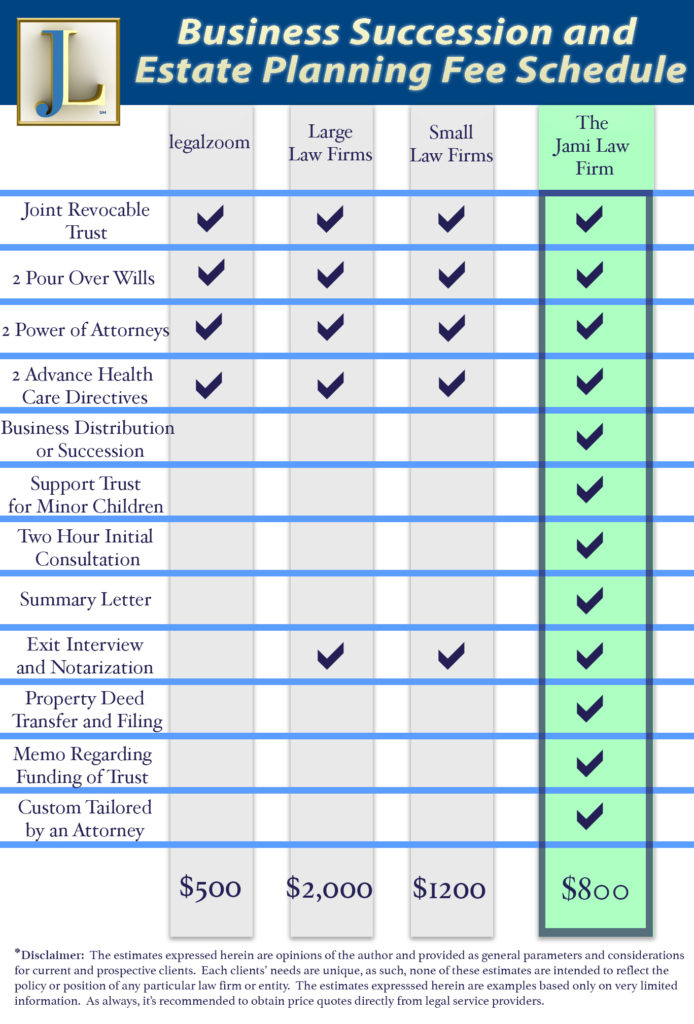
Assuming you want to complete an estate plan, the next step involves finding an attorney to draft all the estate planning documents. The conventional wisdom of California estate planning encourages the use of a revocable living trust. In light of this, a comprehensive estate plan for a married couple typically includes a joint revocable trust, two pour over wills, two durable power of attorneys, two advanced health care directives, naming of conservators, designation of guardians for minor children, and a grant deed and preliminary change of ownership report for real property.
Although it doesn’t take a genius to figure out how an estate should be distributed, it would not be wise to draft an estate plan without the advice or guidance of an attorney. Despite the boilerplate do-it-yourself documents floating around, California is extremely particular about estate planning formalities and California community property rules can be quite complicated. It’s no surprise that you may be attracted to the low cost of do-it-yourself forms, however, considering the relatively inexpensive cost to have an attorney form your estate plan, you would be taking on an unjustified risk doing it yourself. After all, you don’t want to cheat yourself by forming and relying on an estate plan that ends up being invalid or worse, ends up dispensing assets in a manner that is contrary to your wishes.
Of course, for an experienced attorney most estate plans are simple; that is, for an attorney it’s simply a matter of determining all the client’s assets and figuring out how they want these assets distributed upon death. In fact, it’s because of this simplicity that many attorneys moonlight as estate planners–reason being–it’s virtually a plug-and-play process because generally, most people have simple estate plans. That being said, you’re probably wondering what a simple estate plan consists of; essentially it looks something like this: a single family unit consisting of a husband and wife, a few children, a few grandchildren, a home (real property), some personal property, and some bank accounts. Indeed, for many people, a simple estate plan is just what they need.
The real issue arises when the estate plan includes special allocations, business assets, separate property, and tax implications for estates that exceed the estate tax basic exclusion amount of $5,450,000 for 2016. I deem special allocations as those assets where both spouses would plan for distribution in a manner that would not reflect the intestacy statutes of the state.
Intestacy provides for statutes that act as default rules in California, essentially, the legislator has already come up with a set of rules for how your property should be distributed if you don’t contract otherwise. For example; lets say you have three children and you and your spouse die. Under the default provision of the California Probate Code section 240, your property will be distributed evenly amongst your three children. However, let’s assume that all of your three children have predeceased you and your spouse. Further let’s say deceased child 1 left 3 surviving children (your grandchildren); deceased child 2 left 1 surviving child; and deceased child 3 left 2 surviving children. The concern being, should your estate be distributed amongst your deceased children evenly in one-third portions or should it be distributed amongst the nine surviving grandchildren evenly.
In California the default rule would provide for an even distribution amongst all nine grandchildren. However, when I address this issue with most clients, they feel like they would rather have the distribution allocate even shares to their children and then have the grandchildren take from their parent’s respective distributions (California Probate Code section 247). For some people, this may seem like the fairer outcome with the end result providing deceased child 1’s surviving children each with one-ninth of the estate share; deceased child 2’s surviving child one-third of the estate share; and deceased child 3’s surviving children each with one-sixth of the estate share. See comparison chart below.
|
Dead |
Husband & Wife (Estate = 1) |
|||||
|
Dead |
Child 1 | Child 2 |
Child 3 |
|||
|
Living |
Grandchild |
Grandchild | Grandchild | Grandchild | Grandchild |
Grandchild |
|
§240 |
1/6 |
1/6 | 1/6 | 1/6 | 1/6 |
1/6 |
|
§247 |
1/9 | 1/9 | 1/9 | 1/3 | 1/6 |
1/6 |
Moreover, when business assets are involved, the estate plan can include a business succession plan or business liquidation plan. With careful planning, one can avoid estate taxes on a substantial portion of a business transfer by taking advantage of the annual gift tax exclusion.[1]
Furthermore, some parents may feel the need to form a support trust for their minor children or children who have not reached a specific age. For example, some parents may want to distribute their estate into a support trust for the benefit of their child’s education, health, and welfare until the child reaches the age of twenty-five, at which point the remaining trust proceeds would be distributed outright.
Lastly, with respect to the estate tax basic exclusion amount, oftentimes the first spouse to die fails to use their basic exclusion amount when transferring their property to the surviving spouse. If the surviving spouse subsequently dies and leaves an estate greater than the exclusion amount ($5.45 million), the surviving spouse will owe estate tax of forty percent on the surplus. However, as of 2010, the law allows a surviving spouse to be able to use a deceased spouse’s unused exclusion amount if certain criteria are met (formally known as “portability”). Effectively, the surviving spouse may use his exclusion amount and his deceases spouse’s unused exclusion amount in order to transfer up to $10.9 million of assets free of estate tax. It should be noted that a portability election must be filed within nine months after the decedents date of death.
In light of the countless considerations, it is imperative to find an estate planner who can foresee the myriad of taxation and planning issues your estate faces. Of course, the chance of finding an attorney who is expertly familiar with every single issue yet charges a reasonable price is probably rare or non-existent. That being said, the key is to find an attorney who can spot your estate plan issues, foresee the tax consequences, do the research, and address them competently. Not only are these types of attorneys hard to find, but in fact, most clients have no idea whether their attorney has thoroughly vetted all their issues because most clients don’t have a clue about the issues they face. To make matters worse, most clients are unable to observe their estate plan in action because only once the client has departed does the estate plan activate.
As you might imagine, many people fall victim to inadequate estate planning advice; but that doesn’t mean you have to. Find an attorney who is willing to explain all the details of your estate plan, including all the tax implications. Any estate planning attorney worth his/her salt should be willing to explain every asset distribution and its related tax implication. If you sense reluctance form the attorney to answer your questions, this is a tell-tale sign that your estate plan may not be in the best hands.
Copyright © 2016 Tamim Jami
[1] For the years 2015 and 2016, the annual gift tax exclusion amount was $14,000 per person.
Helpful Chart
| Key Federal Transfer Tax Figure | 2015 | 2016 |
| Estate Tax Basic Exclusion Amount | $5,430,000 | $5,450,000 |
| Lifetime Gift Tax Exemption Amount | $5,430,000 | $5,450,000 |
| Annual Gift Tax Exclusion Amount | $14,000 | $14,000 |
| Annual Gift Tax Exclusion Amount to Noncitizen Spouse | $147,000 | $148,000 |
| Generation Skipping Transfer Tax Exemption | $5,430,000 | $5,450,000 |
| Estate, Gift, and Generation Skipping Transfer Tax Rate | 40% | 40% |