 Request a Strategy Session.
  Our Location

LLC electing S-corp tax treatment
Deciding between an S-corp and an LLC requires a prospective entity to appreciate the various aspects of ownership, formality, perpetuity, taxation, and transferability unique to these two forms. Although many entities have an affinity toward forming an LLC, it would be unwise for an entity to overlook the advantages of an S-corp. Hence, the purpose of this segment is to introduce a unique hybrid entity that is often overlooked, the LLC with S-corp tax election. The first reaction I receive from most people is puzzlement and the following question – is this structure even permitted? Unequivocally my response is yes, the election is made by filing IRS form 2553 and I’ve personally filed this election for businesses numerous times. Of course, you must qualify for S-corp election by meeting some modest requirements. At this point, it should come as no surprise that the S-corp and LLC are the primary choices for most businesses. Follow along and I will reveal how you can have the best of both entities.
Simply put, the S-corp provides flexible income allocation that results in favorable tax treatment and the LLC provides simplicity. Blend the two and you get to take advantage of the benefits that are typically exclusive to each entity.
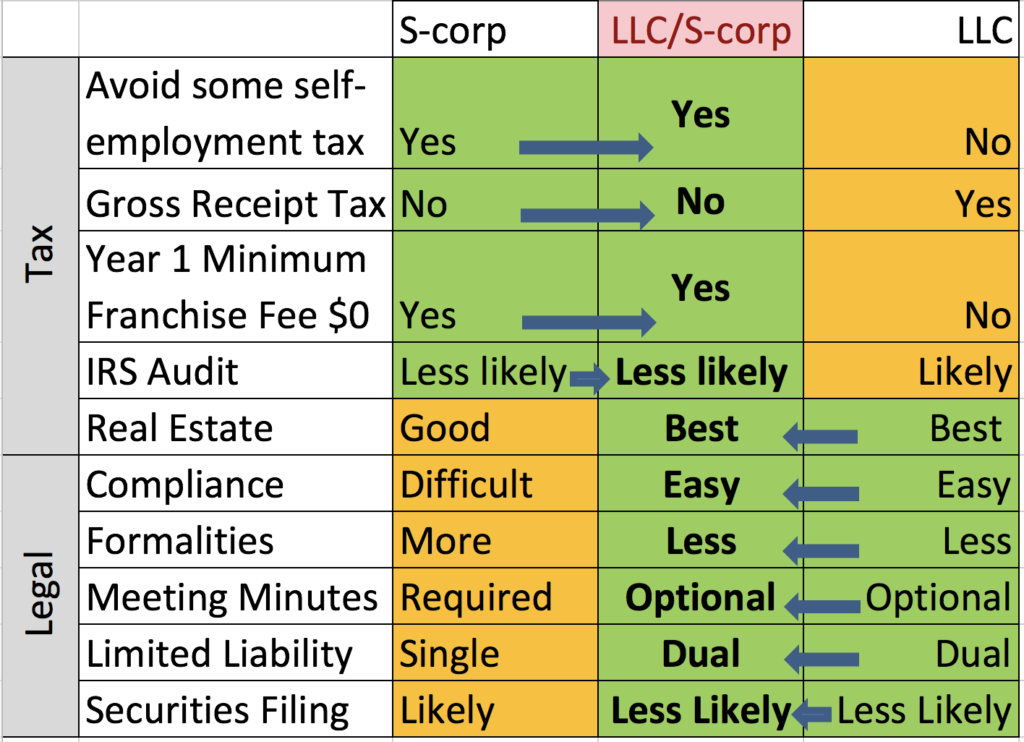
If you choose the LLC/S-corp, the entity is recognized as a LLC for legal purposes (governed under California Law), and recognized as a S-corp for federal tax purposes.
With the LLC/S-corp, you get to allocate income between distributions and salary, thus lowering your self-employment tax liability. Also, the LLC/S-corp is not subject to gross receipt tax for gross sales in excess of $250,000. Furthermore, in the first year of business, you get to avoid the $800 minimum franchise tax which for many small businesses might provide an additional benefit if no or little profit is expected during the first year of business. As far as using this entity for real estate purposes, whether it’s to hold, flip, or transfer property, this entity is ideal; please review my article on real estate entities for a detailed discussion. Lastly, while you can never completely audit-proof your business’s income tax return, based on recent statistics[1] the IRS is ten times less likely to audit an S-corp as opposed to an LLC filing Schedule C. Notably, third-parties making payments to an S-corp are not required to file form 1099-MISC or report to the IRS.
With respect to the legal aspects, the LLC/S-corp compliance is simple; no need for articles of incorporation, bylaws, share certificates or required annual meetings with minutes. Also, with respect to the statement of information that must be filed with the Secretary of State; although the S-corp normally requires an annual filing ($25/year), the LLC/S-corp requires a biannual filing ($20/every other year). It may seem like a trivial fee, however, there is a $250 penalty for each late filing and if you fail to file, your entity can loose the ability to sue or worse it may loose its legal status as a limited liability entity.
Additionally, with the LLC/S-corp, it provides a dual layer of limited liability. Specifically, it fully protects your personal assets from business liability and your business assets from personal liability. This is especially true if you form the LLC in Delaware or Nevada, please review my article titled LLC protection for members’ personal debt for a detailed discussion.
Lastly, the LLC/S-corp allows you to avoid any securities filings for the issuance of securities because with respect to a member-managed LLC, the LLC interests are not considered securities, thus they do not implicate state and federal securities laws.
The only drawback to electing S-corp tax treatment is the added cost for filing an 1120S and payroll. If you do your homework, you can probably find tax preparers who charge fees anywhere from $500-$1500. Keep in mind that you need to choose[2] your tax preparer with care; if the IRS believes a preparer is claiming unwarranted deductions or taking other fraudulent steps on other clients’ returns, then your business will face an additional risk for audit.
[1] http://www.wsj.com/articles/SB10001424052748704754304576096462998700934
[2] For example, if you use an enrolled agent, check with the IRS’ office of Professional Responsibility at opr@irs.gov (include the preparer’s name and address).